Showing posts with label Art. Show all posts

Sunday, 28 February 2016

Amster-dayum - Day 2 - The Rijksmuseum

This is a must do if you visit Amsterdam. I would have liked to do the Van Gogh museum too but ran out of steam. Bloody fibro is sometimes a pain in the arse.


There is a small garden outside the museum that you can explore for free. Knowing my stamina for walking was limited I just took pictures from the walkway into the museum. Love the statues greened with age.


Front of the Rijksmuseum.


Amazing stain glass in hall.


The floor had some gorgeous mosaics.


More stain glass.


More mosaics.


Paintings on the end wall.


View of the entire hallway.


Satyr and Nymph by Gerard van Honthorst. Love the sensuality in this picture.


The Milkmaid by Johannes Vermeer. The light, colour and definition in this was exquisite. I can see why this spot in Vermeer's house was his favourite for posing his models, and appears in many of his paintings. The lighting in this spot is perfect. It was hard to get a good picture of this painting as there were so many people around it.


A ship on the high seas caught in a squall by Willem van de Velde II - the sky in this one reminded me of the Turner's I've seen in the National Gallery.


Festoon of Fruits and Flowers by Jan Davidsz de Heem -  when you look closely at this picture you can see lots of bugs and insects. It is sumptuous and beautiful.


Still Life with Silver Ewer by Willem Kalf - the painting of the silver ewer is just wow. I loved the way the light was bouncing off this piece.


Militia Company of District II Under the Command of Captain Frans Banninck Cocq - otherwise known as The Night Watch - by Rembrandt Harmensz van Rijn. The original painting was wider but canvas was removed from the edges so it could be fitted between two doorways when it was moved to Amsterdam.


Still life with Peacocks by Rembrandt - apparently peacocks were quite the delicacy at some point, the sacrilege!


The Drunken Couple by Jan Havicksz Steen - humorous picture of a drunk couple who are so inebriated they don't realise they are being robbed.


Militia Company of District XI under the Command of Captain Reynier Reael - known as The Meagre Company - painted by Frans Hals and finished by Pieter Codde when Hals failed to deliver the portraits on time. Codde tried to imitate the more flamboyant style of Frans Hals but it is thought he painted the 7 figures on the right of the picture.


Portrait of Eduard Wallis by Johannes Cornelisz Verspronck - this painting looks almost like a photograph. I was really impressed by the detail and quality of it. The subject was a wealthy cloth merchant.


Memorial portrait of Moses ter Borch by Gerard and Gesina ter Borch. It commemorates the life of Moses, he is surrounded by emblems that celebrate his life.


The Battle of the Downs by Willem van de Velde I - spectacular ink on canvas, the detail is almost as fine as you would find on a bank note but the picture is huge.


The Battle of Terheide by Willem van de Velde I - another ink on paper picture with amazing details.


Model of the William Rex - a Dutch warship. The details are amazing.


A celestial globe, with a close up on Leo - Alan's star sign.


A terrestrial globe, this time I focussed on Britain.
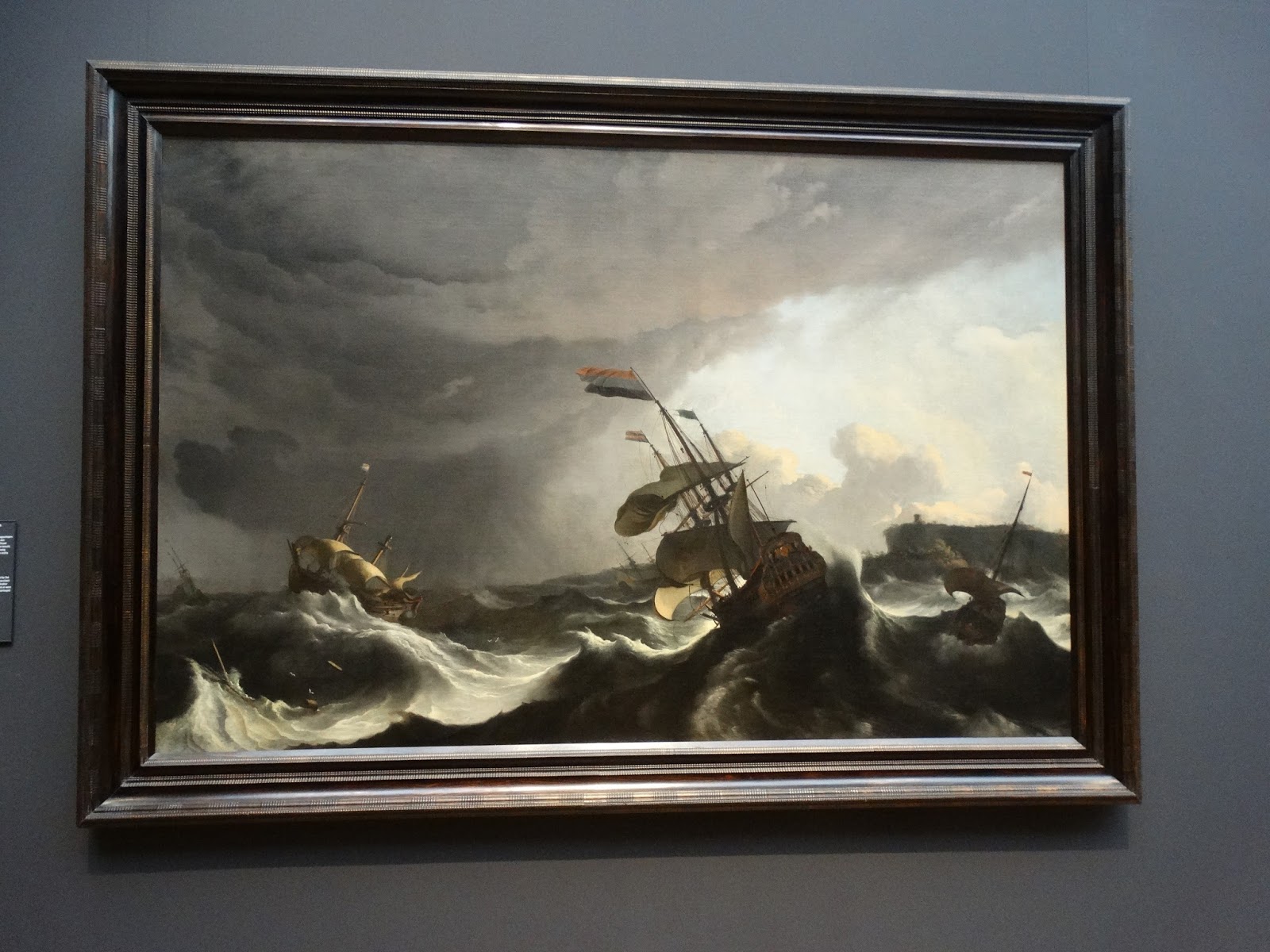

Warships in a Heavy Storm by Ludolf Bakhuysen - The ship at the centre, The Hollandia, was badly damaged in a storm near Gibraltar.


The Cuypers Library and Reading Room in the Rijksmuseum. You can visit here and research the rare and antique manuscripts.


Portrait of Gerard Andriesz Bicker by Bartholomeus van der Helst - portrait of a self assured twenty year old who held administrative positions in Amsterdam like his father, though his portrait is far more flamboyant.


The Corpses of the De Witt Brothers - probably by Jan de Baen - Assassinated by political opponents, the naked and flayed bodies of Johan and Cornelis de Witt were displayed on the Execution Ground of The Hague.


Panel with Pyramis and Thisbe - stone inlaid with mother of pearl and marble. This was just breathtaking.


Allegory of the Sciences by Gerard de Lairesse.  Whilst this looks three dimensional it is a painting.


Saturday, 15 February 2014

Monastiraki, The Herakleidon Museum & Monastiraki again - Athens Day 2

Our first day and we took a quick jaunt through Monastiraki before visiting the Herakleidon Museum.
 
Every trip to Monastiraki reveals more weird and wonderful items for sale once you get past the tourist trap shops to the real flea market.
 
 Now that's a big cock!

 Another picture of the various surgical and medical instruments for sale.


 A handsome Oliver typewriter, with what looks like a French or Belgian arrangement of keys.

 Three acid yellow glass vases that caught my eye.
Onwards to the Herakleidon Museum that is housed in a beautiful Neoclassical building dating from 1898, we were off to see an exhibition on the work of M C Escher.
 
(picture courtesy the Herakleidon Museum)
 
First we saw an exhibition from a Hungarian-French artist Victor Vasarely 


Then to the exhbition on M C Escher
I've included the write up from the exhibition with each print.

Other World (1947) wood engraving
"No matter which way the picture is turned, the vanishing point is always at the centre. All of the planes are at the same time ceilings, floors and walls, and each window leads to conflicting realities."

Ascending Descending (1960) lithograph
"Here Escher seems to be referring to the Dutch expression monk's work meaning tedious and endless labours. These men march up and down on their never-ending staircase 'while two refractory individuals refuse to take part in this spiritual exercise... later they may admit the error of their nonconformity'. The print also represents another illustration of an impossible object that Escher became familiar with through an article written by mathematicians Lionel S Penrose & Roger Penrose: stairs that lead up and down but remain at the same level."

 Print Gallery (1956) lithograph
"In this lithograph we see an exhibition of prints. In the bottom left-hand corner a young man views one of the prints, a rendering of a seaside town. If one looks just below the buildings in the right portion of the work, one notices the entrance to the gallery, beyond which is a young man looking at the exhibited prints. Thus, as the artist himself stated, 'He actually sees himself as a detail of the picture; reality and image are one and the same.' Escher created this illusion by expanding the composition a total of 256 times in a clockwise circular format, beginning at the lower left corner."

 Belvedere (1958) lithograph
This is another example of Escher's exploration of how the two-dimensional plane allows for the construction of buildings that could not possibly exist in the three-dimensional world. The building appears to be a palace, complete with a grimacing prisoner in the dungeon. But notice the small boy in the foreground - he holds the key to this puzzle, an impossible cuboid construction. Escher noted: 'Probably he isn't aware that the building behind him demonstrates the same impossibility. For instance, the ladder in the centre, though correctly drawn according to the rules of perspective and quite acceptable as an object, stands with its base inside the house, but outside with its top. Hence the two persons on it are in an impossible relation to each other."

Verbum (1942) lithograph
"This is the only hexagonal print Escher made, and it was one of the few prints the artist had hung in his own studio. Escher explains: 'An evolution working from the centre outwards, offers more space at the edges for the fully grown figures. The central word Verbum recalls the biblical story of creation. Out of a misty grey there loom triangular primeval figures which, by the time they reach the edges of the hexagon, have developed into birds, fishes and frogs, each in its own element: air, water and earth. Each kind is pictured by day and by night and the creatures merge into each other as they move forward along the outline of the hexagon, in a clockwise direction"

Regular Division of the Plane III (1957) woodcut

 Square Limit (1964) woodcut
Square Limit was made after Escher's Circle Limit series, where he changed the form to a square 'because of the rectilinear nature of walls of our rooms.' Escher created this remarkable print using two triangular woodblocks (a separate one for each colour), each one printed four times around to produce the square."

 Snakes (1969) woodcut
For this, his last print, Escher used the technique of woodcutting, which he favoured all his life. In a letter to his friends Arthur and Loetje Loeb, the artist wrote in July 1969: 'I don't imagine that this will be a masterpiece (although we should really pretend to believe this of each new piece of work), but I'm extremely satisfied because my hand doesn't shake at all, and my eyes are still good enough for such precision work, thanks to a magnifying glass lit up by a circular neon tube (which doesn't heat the wood!). I've been doing this kind of work for over fifty years now and nothing in this strange and frightening world seems more pleasant to me. What more could a person want?"

 Square Limit Circle Limit IV: Heaven and Hell (1960) woodcut
In a book by Professor H S M Coxeter, Escher discovered an illustration that would help him with his explorations of the infinite plane. This illustration expressed the idea that the whole of the infinite plane can be shown as being within a finite circle. From this model Escher created his own constructions of infinity in a series of prints entitled Circle Limit, where the forms diminish in size as they move outwards. Escher said that what he achieved was not a literal representation of infinity, 'but certainly a fragment of it.'"

 Reptiles (1943) Lithograph
Among the finest prints Escher ever produced, Reptiles fascinates us with its clever tessellation drawing from which a lizard springs to life on a circular journey that brings it back to its origins. Every object depicted in this picture belonged to the artist, including his tessallation sketchbook that actually has this drawing in it. These drawings were Escher's 'visual dictionary' in which he systematically recorded every system of interlocking figures."

Knots (1965) woodcut
 This is a later example of Escher's exploration of topological subjects and the relationship between space and the flat surface. Here Escher was working on trying to find a form where the inside and the outside could be viewed simultaneously, a subject he explored numerous times."

Sphere Spirals (1958) woodcut
"The ribbon helps achieve the three-dimensional effect Escher sought."
 
Escher inspired artwork in the courtyard of the Herakleidon Museum.

I wonder if there's been any progress on the restoration of the Parthenon since the last visit? The weather wasn't as cheery as December but comfortably warmer than England. 
 
Back to the hotel via Monastiraki again.
 
Coffee table made from a pinball machine.
 Chopper bike, not for sale, being used as a mode of transport!

 Antique shop with a desk set up with what looks like a mix of pre and post WWII items.

 I made a friend. If I could have fitted him in my suitcase I would have been tempted to bring him home with me.

 Not rodeworthy, but definitely worthy of pride of place in your garden!

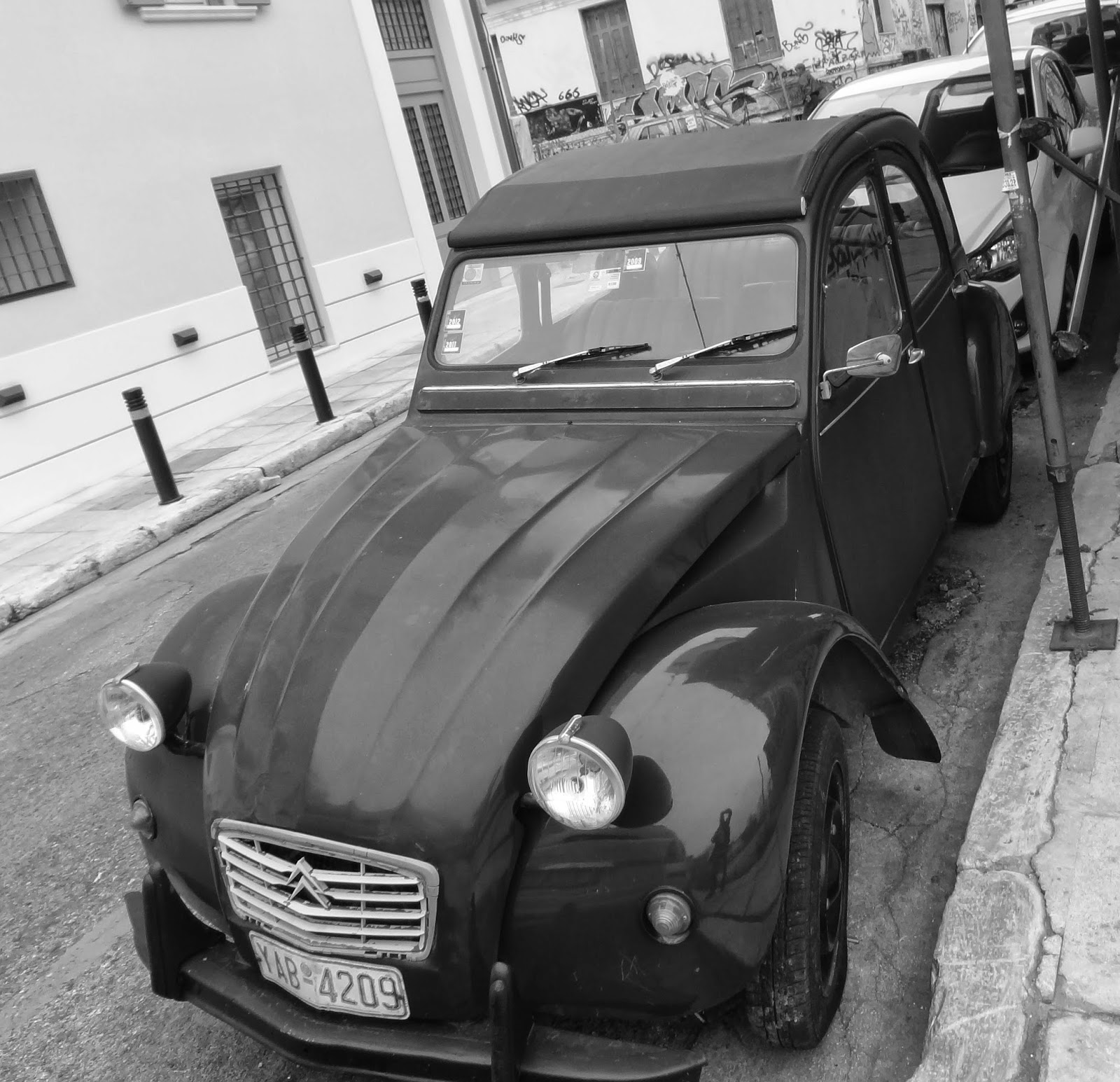
Old Citroen 2CV still being used in Athens.

Another charming creature I missed on my last tour of Athens street art.


 Dinner out in a local tavern in plaka, I had a lamb dish with potatoes. Lovely but too salty for my taste. The lighting in the restaurant was unusual though.


Related Posts with Thumbnails